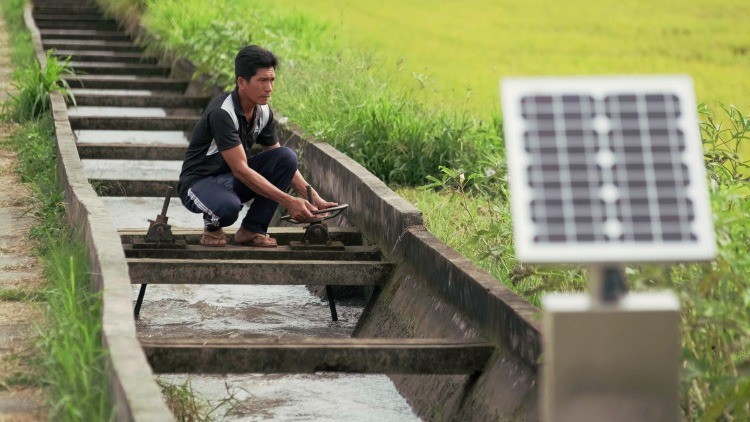
A new report from the World Bank introduces a new framework linking water availability, food production and trade to inform country-level decision making.
By 2050, ten billion people will need to eat and hundreds of millions will need better jobs and stronger livelihoods. Water is central to both. Smarter water management can help food systems produce more sustainably while creating jobs, raising incomes and supporting broader economic growth.
At first glance, this can seem like a problem of water scarcity. But, according to a new World Bank report, the evidence points to a broader challenge – and an opportunity – about how water can be managed to support food production, jobs and growth.
Global agriculture remains one of humanity’s greatest achievements, feeding billions every day. But as the population grows – by around 200,000 people daily – and climate-driven water stress intensifies, the challenge is whether food production can be sustained while supporting livelihoods and economic growth.
The real challenge is not how much water the planet has, but how unevenly it is used to grow food across the world. Some regions underuse abundant water, holding back growth, jobs and incomes. Others continue to produce food by overexploiting already scarce resources – sometimes exporting crops they cannot sustainably support. This imbalance is not inevitable – it reflects policy and investment choices and it can be addressed.
The answer starts with the management of water. The World Bank Group’s Nourish and Flourish report shows that smarter water management for agriculture is central to meeting this challenge.
Countries face different starting points when it comes to water and food production. Some have abundant water and untapped agricultural potential and others are already under severe water stress and need to use every drop more productively. Some rely on food imports as a deliberate economic strategy, while others are import-dependent not by choice but by necessity, held back by inadequate infrastructure and unrealised agricultural potential. And others are major exporters shaping global markets.
These differences matter. The path forward is not a single solution, but better alignment between water, food production and economic priorities, tailored to each country’s reality.
In regions where rainfall is unreliable, sustainable irrigation can sharply increase yields, sometimes more than doubling them. It can also create at least 245 million jobs globally, particularly where agriculture remains central to livelihoods. Better water management is not just about food, it is a powerful driver of jobs and growth.
Turning this into results requires three shifts says the Nourish and Flourish report.
First, stronger coordination and leadership. Countries that have successfully transformed agricultural water systems treat water as a strategic issue, bringing together agriculture, environment, finance, water institutions and broader society around a shared vision.
Second, shift incentives and services toward performance. Too often, public spending rewards overuse or stops at infrastructure. The opportunity is to focus on reliable service delivery, with clear accountability for results. With the right policies and regulations, governments can crowd in private sector participation, scale investment and deliver better outcomes for farmers.
Third, use data and technology to guide decisions. Too many decisions are still made with incomplete information. Expanding satellite data, digital tools and open systems can improve planning, strengthen accountability and enable smarter water use.
The World Bank’s Nourish and Flourish report documents many of these solutions to demonstrate how countries are expanding irrigation sustainably where water is available, improving water productivity where it is scarce and mobilising private capital through stronger policies, partnerships and risk-sharing mechanisms.
Click here to download the World Bank’s Nourish and Flourish report.